 Ted Tanner, CEO and Co-Founder
Most operators think their next big jump in revenue will come from expansion: another building, more rooms, new lights, new genetics. In reality, the biggest opportunity may be sitting in the rooms they already own. Turning a 50 g/ft² facility into a 100 g/ft² facility could mean a seven-figure shift in annual revenue without adding a single square foot or hiring another trimmer.
Yet most teams spend more energy shopping for equipment than extracting everything they can from their current canopy. They chase discounts on nutrients and power while leaving millions in unproduced biomass on the table.
If you’re serious about running a high‑performance facility, the question to ask is, “How can we get everything we can out of every square foot we already have, before we add more?”
The Invisible Revenue Leak
The first thing to slip is process discipline: A dialed-in recipe in your flagship facility turns into several slightly different versions once you add new buildings, shifts, and teams. Watering schedules, target moisture levels, and temperature ranges quietly diverge from what is written in your SOPs.
The second failure is lost visibility. Handwritten logs, disconnected controllers, and “I just know this strain” intuition do not scale beyond a couple of rooms. Without clear trends for root-zone moisture, nutrient strength, and room conditions, problems usually surface only after a batch fails testing or a harvest report looks off.
Finally, manual controls reach their limit. Simple timers and one-off fertigation rigs cannot keep up with dozens of zones, overlapping crops, and different recipes. Your best people spend their days reacting to issues instead of preventing them.
Make Quality Measurable
When margins tighten, most teams swing hard in one of two directions: cut costs or chase more square footage. Trim labor, renegotiate vendors, hunt for cheaper inputs; or, start planning the next buildout. Both moves might change the balance sheet at the margins. But they ignore the largest lever on the P&L: total grams produced per square foot of canopy. That’s your true cannabis yields benchmark.
Growers will happily talk about:
-
New LEDs and upgraded fixtures
-
The latest genetics drop
-
Expansion plans, new rooms, and new licenses
But they rarely put the same scrutiny on:
-
Root-zone optimization
- Crop steering precision
- Tight environmental synchronization between zones and rooms
A slightly under-steered crop doesn’t trigger an alarm. Dry-backs that are a bit too slow, or EC profiles that drift off target, still produce sellable product. On paper, everything looks “fine.”
But performance gaps across a 10,000-ft² facility can add up to millions in lost revenue over a year. The cost isn’t just energy or labor inefficiency—it’s every gram you never produced because the canopy stays stuck at 60–80 g/ft² instead of 100 g+.
The Real Cost of Suboptimal Yield
Here are three different scenarios for a flowering facility of 10,000 ft²:
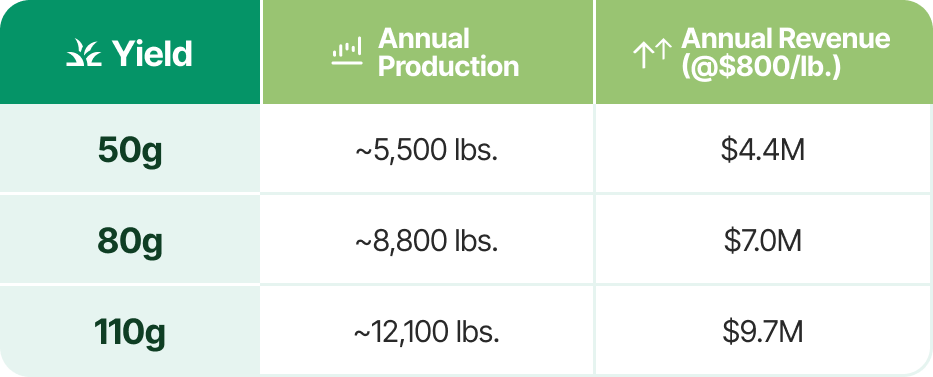
That 30 g/ft² jump from 80 to 110 adds $2.7M annually without expanding a single wall, pulling a new permit, or adding a license. Same building, same headcount, same power service.
This is where an ROI calculator truly matters. Once you plug your own square footage, grams per square foot, and price per pound into a simple model, the gap stops being theoretical and becomes a hard dollar target.
If you want to see what a 20–30 g/ft² lift looks like in your own facility, plug your numbers into our ROI calculator.
Why Facilities Stall at 60–80 g
Most underperforming rooms aren’t failing. They’re “almost right.” Here are some patterns that quietly lock facilities into that 60–80 g/ft² range.
Guess-based irrigation schedules
Irrigation is often driven by timers and gut feel. It’s consistent enough to harvest, but not precise enough to achieve the growth you want within a single facility.
Manual EC management
EC is treated as a static number in the fertigation tank instead of a dynamic profile in the substrate. You might spot-check runoff, but you’re not tracking how EC stacks, plateaus, and bleeds off during the day.
Reactive climate control
Climate is managed reactively. You chase swings instead of shaping VPD, and setpoints drift as canopy density, seasons, or workloads change.
Human pattern bias
People manage by observation of what the tops look like, how leaves feel, how fast pots seem to dry down. In other words, “This is how we’ve always run this room.”
Plants respond by physiology: osmotic pressure, root‑zone oxygen, stomatal behavior, internal nutrient balance. That gap between what we see and what the plant experiences is where facilities get stuck at 60–80 g/ft². Infrequent substrate measurements only widen that gap, because you’re never actually seeing how the root zone behaves across the day and cycle.
The Missing Layer: Root-Zone Intelligence
Most serious operations watch climate. Room temp, RH, CO₂, light intensity—that’s table stakes. The differentiator is who watches root behavior with the same intensity.
Root-zone intelligence means treating the root system as the primary control surface. You’re tracking how water, nutrients, and oxygen move through the substrate over time—not just whether pots feel “light.”
Key levers include:
-
Dry-back precision: Targeting specific percentage losses between irrigations by phase and cultivar.
-
EC stacking: Intentionally building and releasing EC in the substrate to steer between vegetative and generative growth.
-
Pulse fertigation: Smaller, more frequent shots to keep moisture and EC in a tight window.
-
Oxygen management: Avoiding chronic saturation and compaction to protect root-zone oxygen.
When this is dialed in, irrigation stops being a chore and becomes your main steering tool. You can shape dry-backs by the hour and keep plants in their “happy zone” much longer.
This is where a fertigation intelligence platform and modern cultivation software earn their keep. Instead of scattered readings and clipboards, you get a continuous picture of moisture, EC, and temperature trends at the root level.
You move from “this room feels a little wet” to “we’re only hitting 4–5% dry-back between the second and third shots; we need to adjust timing or volume.” That’s how you shift from personality-driven results to a repeatable system.
Why AI Is Essential to Hitting 100 g+
At 100 g/ft² and beyond, everything is connected. More light changes transpiration. Transpiration changes dry-back. Dry-back interacts with EC, which interacts with nutrient uptake and plant stress.
Humans can’t juggle that many moving parts in real time across dozens of zones, cultivars, and crop stages. Not consistently, and not at commercial scale. That’s where artificial intelligence (AI) in your cultivation app and control stack becomes practical.
An AI-driven irrigation and climate engine can:
-
Detect plant stress before visual symptoms
-
Optimize irrigation timing from real dry-back curves, not guesses
-
Coordinate irrigation with light and climate to maintain peak transpiration zones
-
Keep plants in “perfect day” mode more often, including nights, weekends, and shift changes
You set the strategy: target dry-backs, EC windows, generative vs vegetative goals. The AI handles execution: shot timing, frequency, and micro-adjustments to match what plants are actually doing.
That’s what it takes to make 100 g+ a baseline instead of a one-off “hero run.”
The New Operator Mindset
The old mindset: “How fast can we grow our footprint?” Add rooms, add facilities, add licenses. The new mindset to consider: “How do we extract more production from every square foot we’re already paying for?” That means:
-
Pushing yield per square foot, not just cutting dollars per square foot
-
Turning irrigation and climate from static recipes into responsive systems
-
Standardizing what works in your best rooms and scaling it across the footprint
Elite facilities are investing in automation, intelligence, and predictive control. They’re putting sensor controllers and substrate sensor data into one place, using a grow room controller and tools like the Growlink precision irrigation controller to actually act on it.
Expanding footprint without fixing performance is defensive—it masks problems with more square footage. Unlocking production from the rooms you already own is offensive. Only that shift raises the ceiling on what your business can become.
The Million-Dollar Decision
If you’re reading this, you may already own the infrastructure that could produce 100 g+ per square foot. Lights, tables, fertigation lines, HVAC—it’s all there.
What’s missing is the intelligence layer that makes that infrastructure perform at its potential. That layer is root-zone intelligence, AI-driven irrigation and climate control, and a unified cultivation software stack that turns your best runs into standard practice across every room and site. These are the tools that turn the infrastructure you already own into a system where high production is the default.
.png?width=940&height=434&name=image%2029%20(1).png)
