 Ted Tanner, CEO and Co-Founder
When wholesale prices drop and shelves get crowded, the first instinct for most operators is to cut spend and hope margin follows. Power, nutrients, labor, CO₂ — everything goes on the chopping block.
It’s understandable. But the data suggests it often backfires.
The numbers tell the story. According to Whitney Economics, only 27.3% of U.S. cannabis operators were profitable in 2024 — compared to 65.3% of all U.S. small businesses. The U.S. Cannabis Spot Index fell from $1,665/lb in late 2020 to $888/lb by early 2025. A Wells Fargo/Cannabiz Media survey found 59% of growers selling wholesale flower below the average breakeven price of $800/lb.
In that environment, every line item becomes a target. The fastest way to wreck your operation’s long-term economics isn’t to overspend on inputs. It’s to starve the systems that drive yield — then watch your cost-per-pound quietly climb as your rooms produce less, not more.
The metric that matters most isn’t cost-per-pound. It’s revenue per square foot: how much sellable output you’re pulling from every room, cycle after cycle. And in a margin-compressed market, that number is where the real separation between operators happens.
This article outlines how serious operators approach cannabis production scaling so quality improves as their footprint grows. It is written for teams who already run tight rooms and now need those same standards to hold across buildings, states, and partners.
.png?width=940&height=460&name=Image%20(1).png)
Why Cost-Cutting Feels Right — and Why It Isn’t
Fear shows up fast when prices turn. Finance pushes hard to “tighten up.” The moves that follow are usually the same across the industry — and they’re all documented:
-
Dimming lights or shortening photoperiods to trim the power bill
-
Letting room temps and VPD drift wider to save on HVAC and dehu run time
-
Reducing irrigation frequency without substrate sensors to guide the decision
-
Backing off CO₂ targets because it starts to feel like a luxury
These aren’t hypothetical behaviors. Operators have told MJBizDaily they stagger lighting across their facility so only half the lights run at a time — specifically to reduce energy demand. Others have implemented targeted dimming strategies that cut power bills by over $250,000 per year. On CO₂, grower forums and trade press reflect the same calculus: when margins tighten, enrichment is often the first sophisticated input to go.
On paper, these reductions look rational. Line items shrink. Cash flow bumps for a month or two. But biologically, you’ve just pulled resources from the band where your plants express their full genetic potential. You’re trading short-term relief for long-term drag on every harvest report that follows.
What Actually Happens When You Pull Back
Plants respond to physics and biology — not spreadsheets. When you reduce environmental intensity and irrigation precision without data guiding those decisions, a predictable cascade follows:
-
Lower transpiration. Suboptimal VPD and reduced CO₂ slow the engine that moves water and calcium through the plant. Calcium and boron — critical for cell wall integrity and flower development — move exclusively through the transpiration stream. Restrict it and you create deficiencies that show up as tip burn, poor fill, and reduced density.
-
Root-zone drift. Without tight irrigation management guided by real-time substrate data, water content and EC in the slab drift outside the bands where your plants are actually taking up what they need.
-
Smaller flowers, lower bud-to-leaf ratio. The plant never fills the canopy you built. More trim waste, less Grade A sellable weight per harvest. University of Guelph research confirmed a linear relationship between light intensity and flower yield — meaning every PPFD point you dial back has a direct yield cost.
-
Less buffer when something goes wrong. A plant running at marginal inputs has far less resilience when equipment hiccups, a VPD swing runs hard, or an IPM issue surfaces.
Simply put: unmanaged cost-cutting silently cuts yield. You’re paying for the rooms, the license, and the labor either way. The only real question is whether you’re pulling the levers that turn those fixed costs into maximum sellable output.
The Yield Math Both Your Head Grower and CFO Can Respect
Let’s put numbers to it.
Say you cut $10,000 a month out of operating expenses. Over a year, that’s $120,000 saved — helpful, but it has a hard ceiling. You can only reduce inputs so far before you start breaking the system.
Now consider what happens on the yield side. A facility producing 2,000 pounds per year that improves canopy performance by 25% through tighter environmental control and data-driven irrigation has just unlocked 500 additional pounds annually. At the 2025 U.S. Cannabis Spot Index average of approximately $1,078/lb for indoor flower (Cannabis Benchmarks), that’s roughly $539,000 in additional gross revenue — without adding a single room.
That’s not a hypothetical. Elite indoor operations are consistently hitting 80–90+ grams per square foot. Facilities in the 40–50 g/sqft range have real room to move.
-
One path squeezes a fixed number. The other expands the base every other metric sits on:
-
More sellable weight per room and per table
-
Better batch consistency and fewer write-off harvests
-
Stronger ability to prioritize premium SKUs instead of pushing biomass
As MJBizDaily put it in its cultivation profitability guide: “Anybody can grow cannabis. Growing it well and doing it consistently is the tough part.” Operators who get consistency right are better positioned to survive — and thrive — in a margin-compressed market.
.png?width=996&height=487&name=Image%20(2).png)
A Note on Irrigation: Precision Isn’t the Same as More
One common misread of the yield optimization argument is that it means pushing harder on every input, all the time. That’s not what the best operations are doing.
Take irrigation. Elite growers don’t just water more frequently — they manage controlled drybacks with precision. Deliberate morning drybacks of 10–20% in flower, guided by real-time substrate sensors, are a core crop steering technique used by the best cultivation teams in the country. That’s not cost-cutting. That’s dialing in.
The difference between an operation leaving money on the table and one hitting its genetic ceiling is almost never about spending more across the board. It’s about executing more precisely. Knowing exactly when to water and when to let the slab dry. Holding VPD within ±0.1 kPa of target instead of letting it float across a 0.8 kPa window. Running CO₂ at 1,200–1,400 ppm because your DLI supports it, not just because the tank is full.
That precision is what protects yield when the rest of the market is grabbing blunt levers.
Why Dialed-In Grows Are Actually More Resilient
There’s a perception that pushing for higher production is riskier. In practice, the opposite is true when your system is built on data and repeatable execution.
Tightly controlled, high-output grows:
-
Build more margin buffer. Each room generates more dollars per square foot, giving you the room to absorb price drops and temporary inefficiencies. With 73% of U.S. operators unprofitable (Whitney Economics), margin buffer isn’t a luxury — it’s a survival variable.
-
Survive price compression longer. When prices sink, low-yield rooms go underwater first. High-output facilities can still cover fixed costs and stay profitable. We have Growlink customers running profitable operations in markets where wholesale flower is trading below $600 a pound. That’s not luck — it’s what happens when you treat precision as a business strategy, not a nice-to-have.
-
Handle regulatory and compliance shocks better. New testing standards, packaging changes, and compliance burdens all hit cost structure. Higher revenue per square foot softens the blow. Colorado’s record 17 cannabis product recalls in 2023 — up from 3 in 2019 — suggest that cultivation shortcuts create downstream compliance risk as well as yield loss.
-
Make better capital decisions. With clear, repeatable yield performance, you can justify targeted upgrades based on real payback data — not hope.
Operational risk isn’t about how hard your plants are running. It’s about how much control and repeatability you have while they run, day in and day out.
Going From Feel to Data
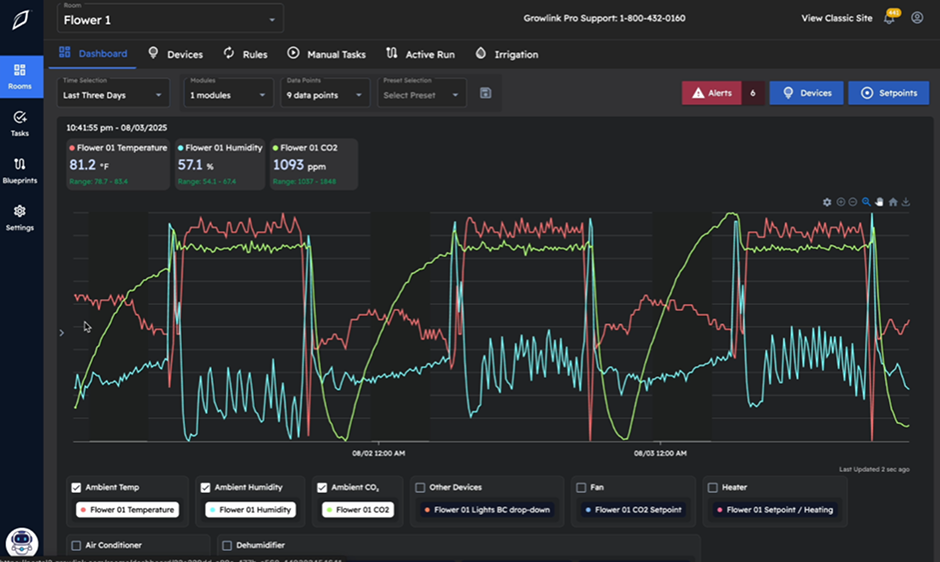
Many operations still rely primarily on feel: walk the rooms, look at the plants, tweak the valves , and see what shows up on the harvest report. That instinct has real value — but it has limits when you're trying to replicate results across multiple rooms or facilities.
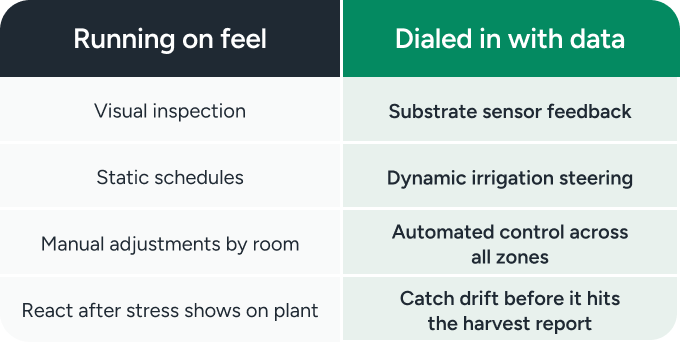
In the data-driven model, your best cultivator’s instincts get captured as SOPs, target bands, and irrigation programs — then executed consistently across every table and room. You can run tighter VPD, more assertive steering strategies, and higher CO₂ targets because you can see exactly what the plant is doing and correct before it becomes an expensive problem.
The New Survival Strategy
In a compressed market, turning down the knobs feels safe. But as the data shows, that move slowly erodes yield, consistency, and resilience — the three things that determine who’s still operating in five years.
The operations best positioned for the next decade are the ones producing the most per square foot, consistently, run after run.
If you’re ready to move beyond cost-cutting and start building the execution system that drives real revenue per square foot, talk to a Growlink advisor to see how leading operators are putting this into practice.
Whitney Economics Cannabis Business Conditions Survey, 2024
Cannabis Benchmarks U.S. Cannabis Spot Index, 2025 Year-End Recap
MJBizDaily: “How cannabis cultivators can manage their energy costs”
MJBizDaily: “The secrets to making cannabis cultivation profitable”
Llewellyn et al., University of Guelph: “Cannabis Yield, Potency, and Leaf Photosynthesis Respond Differently to Increasing Light Levels,” Frontiers in Plant Science, 2021
Ready to grow smarter?
